Setting up a router usually goes smoothly—until you are suddenly asked for an SSID, WPA2, or an IP address. For support teams, these terms are part of everyday life. For many customers, however, this is the moment a simple self-service process turns into a research project. If they don't understand what is meant or what the next step is, they often leave the app, search for an explanation, or contact support.
A self-service app can be technically complete and still miss its mark. The deciding factor is not just which features are available, but whether users can complete the process without additional help. Contextual explanations address exactly this point. They reduce friction and help users complete tasks like router setup, Wi-Fi optimization, or network diagnostics independently.
Why self-service processes fail despite functional technology
Many internet service providers continuously invest in their digital customer service. Customers can set up their routers, connect devices, or analyze technical problems themselves. The necessary features are there. Nevertheless, many processes are interrupted. The reason is often not the technology, but a lack of guidance. Terms like SSID, WPA2, or ONT are hard to avoid in technical processes. They only become problematic when their meaning or the next required action remains unclear. A simple task suddenly turns into a research project. The real challenge, therefore, lies not in the term itself, but in the lack of context.
The real break happens outside the app
Good self-service guides you through a process step by step. If an understandable explanation is missing at any point, the flow is disrupted. This switching between the app and external information sources is known as a media break. The technical error often does not originate in the network or the router at all. The uncertainty arises because users have to interpret information from various sources themselves and apply it to their own situation. Every additional step increases the effort and makes it more likely that the actual self-service process will not be completed.
Why clarity is part of good digital services
As of June 28, 2025, Germany has been subject to the Accessibility Strengthening Act (BFSG), which implements the European Accessibility Act. Accessibility is often associated with technical requirements such as contrast, keyboard navigation, or screen reader compatibility. However, clarity also plays an important role in digital service processes.
Information is only helpful when users understand
- what a term means,
- why it is important at that moment,
- what action to take as a result.
Clarity therefore not only supports user guidance but is also a key component of accessible digital services.
Why classic FAQs often come too late
Help pages and FAQs remain an important part of digital customer service. However, at the crucial moment, they are often of limited use. The actual question does not arise on an FAQ page, but during router setup, network diagnostics, or Wi-Fi optimization. If users have to leave the app, search for the right article, and then apply the information to their situation, the actual process has already been interrupted. That is why explanations are most effective when they appear directly next to the term or process step – exactly where the question arises.
Contextual explanations provide guidance
A helpful explanation does not have to be long. It answers three simple questions:
- What does this term mean?
- Why is it relevant here?
- What should I do now?
This turns a purely technical definition into a concrete recommendation for action. Users have to interpret less and can continue the ongoing process immediately. Contextual explanations do not replace a knowledge base or FAQ. They perform a different task: they provide guidance at the exact moment it is needed.
How MyProvider explains technical terms during the process
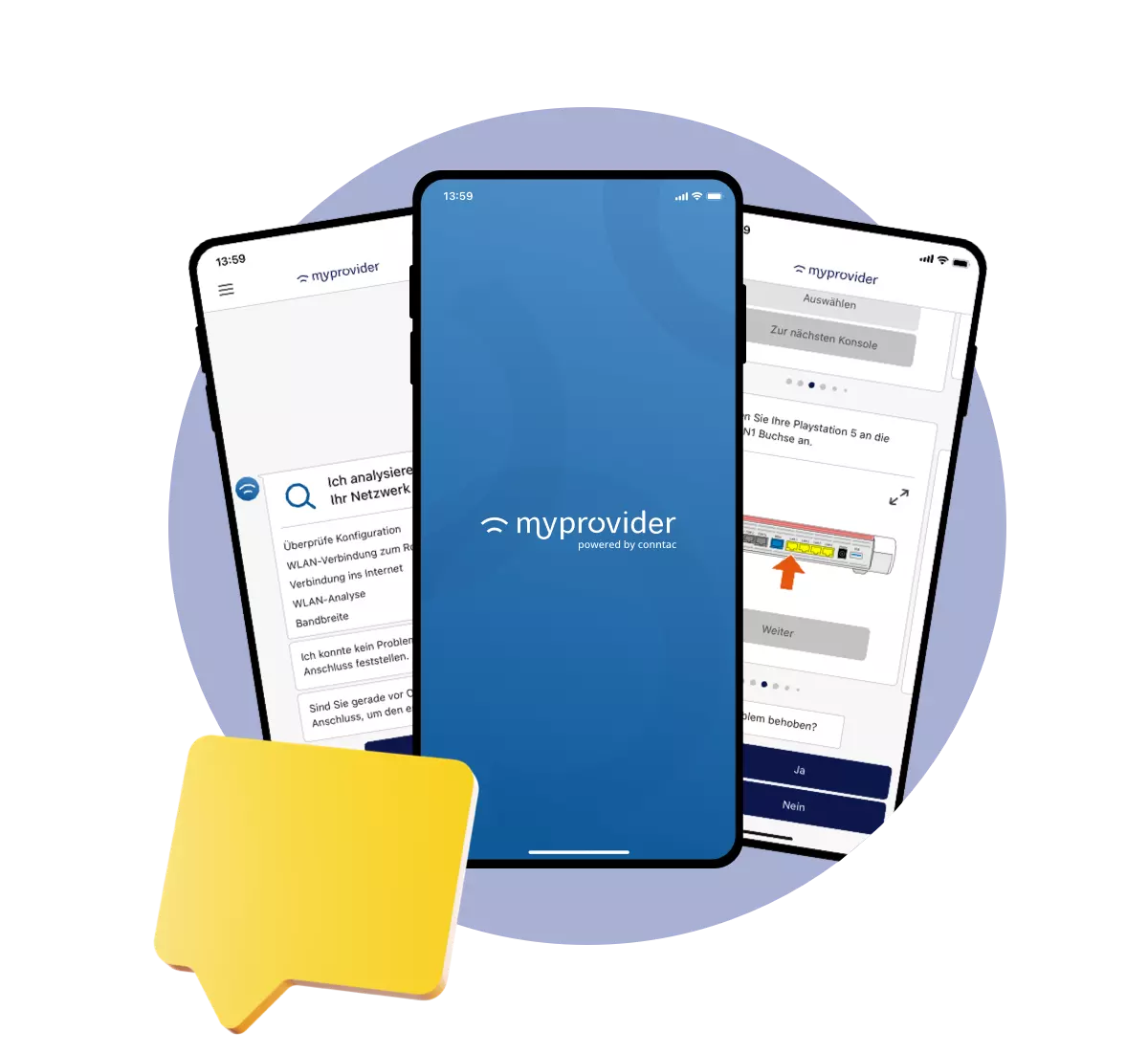
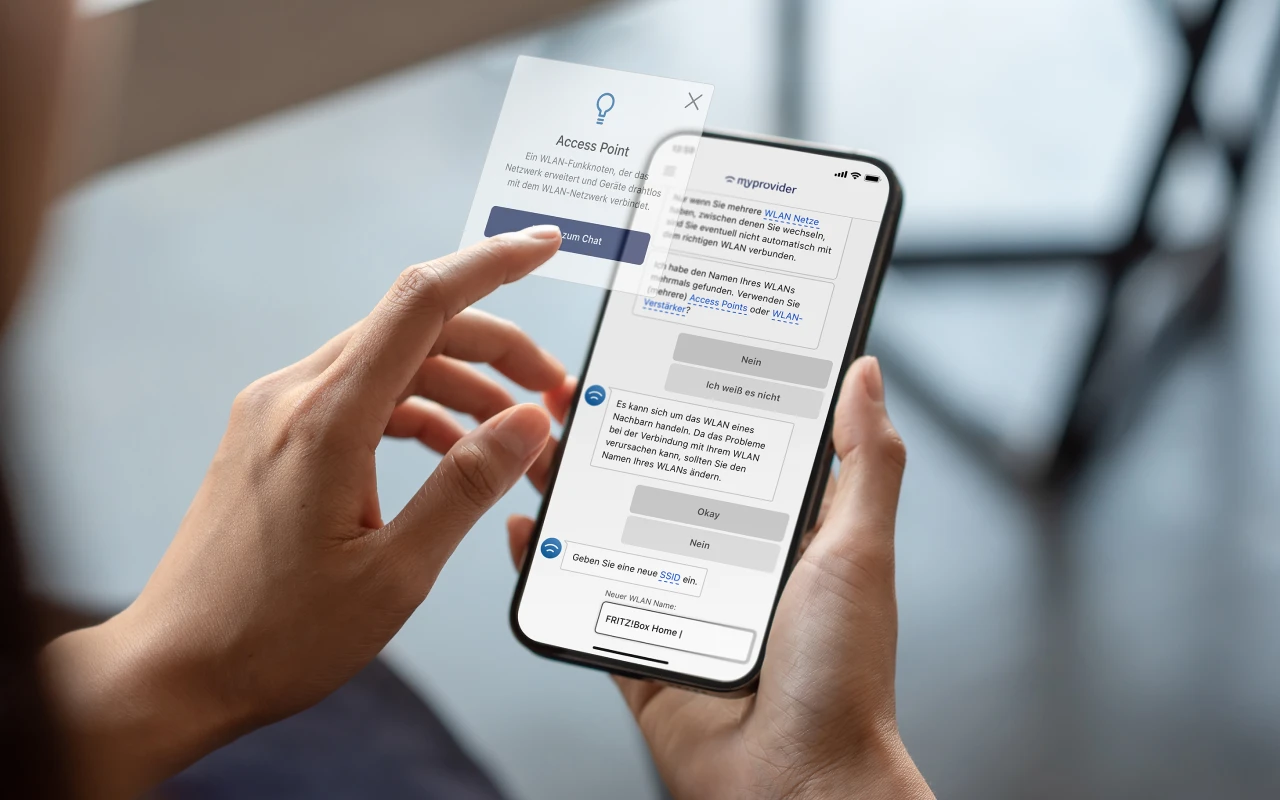
This is exactly where the Smart Wiki in the MyProvider app comes in. Technical terms are explained directly within the current context of use. Users get the necessary guidance while setting up their router, optimizing their Wi-Fi, or troubleshooting and can continue the ongoing process immediately. In this way, the Smart Wiki adds an extra layer of guidance to existing self-service functions—without users having to switch between the app, search engines, and help pages.
Conclusion
The success of a self-service app depends on more than just its range of features. What matters is whether users understand the next step and can carry it out with confidence. Contextual explanations help reduce friction and make digital service processes easier to understand. This benefits both customers and internet service providers: processes can be completed independently more often, and avoidable inquiries can be reduced.
From problem to solution
How can internet service providers design intuitive self-service processes?
In our playbook “Understandable Self-Service for Internet Service Providers” you will learn why guidance is a key success factor for digital service processes and how to design technical terminology, user navigation, and contextual explanations to reduce friction and increase the number of successfully completed self-service processes.
→ Download the playbook now (DE)
FAQ
What is a smart wiki in a self-service app?
A smart wiki provides brief explanations directly within a digital service process. Technical terms are explained in the context of the current step, so users don't have to leave the app to search for information elsewhere.
Why do technical terms lead to self-service abandonment?
Because users often don't understand what a term means or what action they need to take as a result. This turns a straightforward process into an extra research task.
How do contextual explanations reduce friction in the user journey?
They answer questions exactly where they arise. External search engines, forums, or help pages are needed much less frequently.
What role does clarity play in digital accessibility?
Beyond technical accessibility, clear language helps users correctly interpret information and use digital services with confidence.
How should internet service providers explain technical terms?
Briefly, clearly, and directly within the context of use—with a clear explanation and a concrete next step. How easy customers find a process can be measured using, among other things, the Customer Effort Score (CES) .