Why “slow Internet” is rarely a network problem
“The Internet is slow. ”
Hardly a sentence is used more frequently in the customer service of Internet providers. But practice shows time and again: In many cases, the cause is not the provider's network, but in the customer's home network – more precisely in WiFi.
For service teams, this creates a structural challenge. Because what looks like a network problem for end customers is often a local radio problem within the home. The result is unnecessary hotline contacts, long explanatory processes and, in some cases, even technician assignments without actual disruption.
The decisive question is therefore not: How do we process these inquiries faster?
Instead: How do we prevent them from ending up in support in the first place?

Why are there so many WiFi-related support requests?
WiFi is invisible to end customers.
While the Internet connection is perceived as a contractual service, the wireless connection within one's own four walls remains abstract. Signal strength, attenuation caused by walls or the position of the router are not tangible for most users.
If there are delays in streaming or disconnections, the problem is automatically attributed to the “Internet” – not to the WiFi.
Typical consequences in service:
- Calls with the description “Internet slow”
- Long discussions to narrow down the cause
- Trial and error during restarts and relocations
- Technician appointments without network disruption
- Router replacement with unchanged home network setup
From an operational point of view, there is a great deal of effort for a type of problem, which in many cases could be solved locally.
What is the actual structural problem?
The core problem is not technology, but the lack of transparency.
As long as end customers are unable to identify exactly where the cause lies, only assumptions remain. Assumptions lead to calls. Phone calls lead to explanations. Explanations tie up capacities.
In the classic service process, it often looks like this:
- Customer reports “Internet slow”
- Support checks line values
- No network problem can be identified
- Suspicion of WiFi
- Explanations of router position or repeater usage
This process is reactive and labor-intensive. It scales poorly – especially in phases of strong growth, fiber optic rollouts, or migration projects.
→ Customer effort in technical support

How can ISPs structurally reduce WiFi problems?
The most effective change is not achieved by faster processing, but by postponing the process.
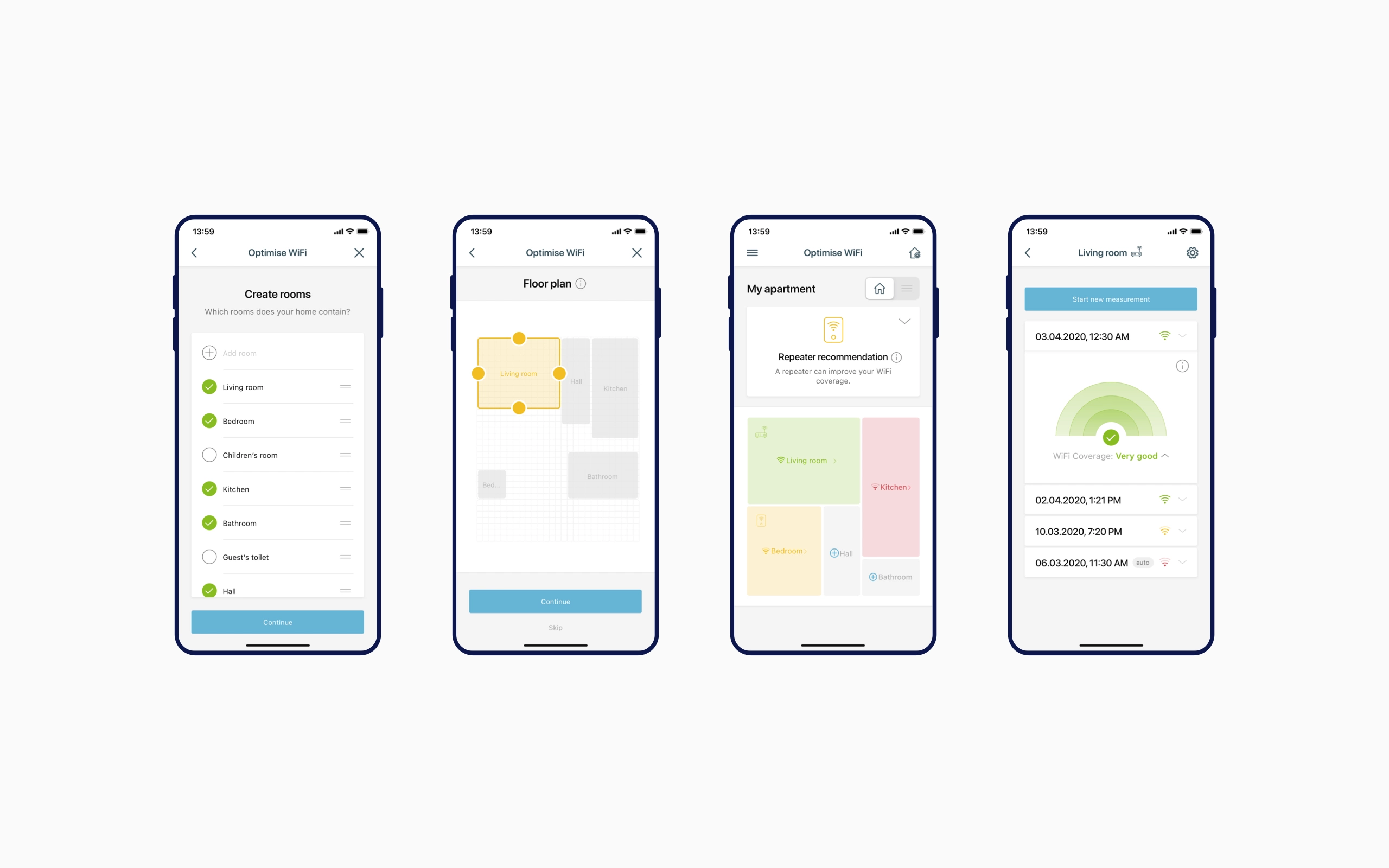
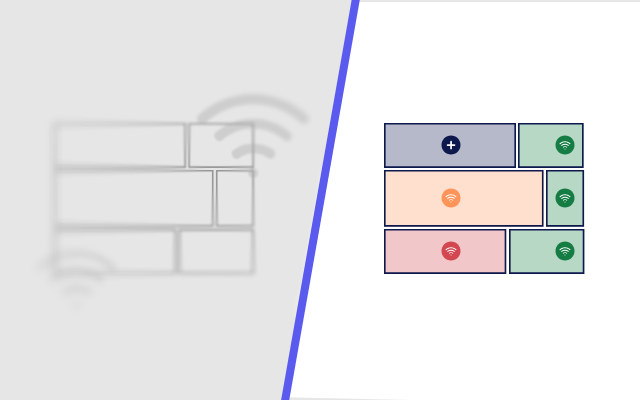
When customers can measure and visualize their WiFi themselves, the initial situation changes fundamentally. A guess becomes a concrete analysis. Uncertainty creates orientation.
A guided self-service feature walks customers through the troubleshooting process, guiding them step by step through the analysis. This enables:
- Room-by-room measurements
- Visual presentation of weak signal areas
- Specific recommendations for action
- Tips for optimal placement of repeaters
This makes WiFi comprehensible for the first time. This not only reduces support contacts, but also improves the quality of calls should a contact arise. Customers start talking with specific information – or solve the problem already self-employed.
Why is the topic particularly relevant in fibre-optic construction?
Expectations also grow as bandwidths increase.
When a fiber optic connection is booked, customers expect maximum performance in every room. In reality, however, the performance of the connection is often limited by unfavorable router positions, structural conditions or a lack of repeaters.
The higher the bandwidth, the more sensitive users are to perceived deviations. This also increases the potential for WiFi-related support requests.
Especially during expansion phases or when migrating from copper to fiber optics, it becomes clear that the service organization must not only operate the network stably, but also take a closer look at the home network.
→ Optical fiber activation after expansion
What economic effects are possible?
A systematic WiFi analysis on the customer side works on several levels:
Reduction of first-level contacts
When standard problems are solved by yourself, the ticket volume decreases in 1st level.
Shorter call times
If an analysis has already been carried out, support can work in a more targeted manner.
Fewer unnecessary field service assignments
Technicians are only scheduled when there is actually a network problem.
Better differentiation between WiFi and network
Internal fault diagnosis is becoming clearer and more efficient. It is not only the call reduction that is decisive. It's about process clarity and scalability.
From response to prevention
Service organizations are under increasing pressure: increasing customer numbers, a shortage of skilled workers, higher expectations of availability and speed.
WiFi-related inquiries are among the most common support issues – and are also one of the areas with the greatest automation potential.
Anyone who manages to create transparency in the home network is shifting a relevant part of the support effort from the hotline to a structured self-service process.
This is not cosmetic optimization, but a systemic change.
Conclusion: Make WiFi visible instead of managing tickets
“Internet slow” is rarely just a technical problem. It is often a transparency issue.
As long as WiFi remains invisible, assumptions arise. And assumptions end up in support.
Digital tools for WiFi analysis make it possible to start precisely at this point. They make the home network comprehensible and reduce uncertainty – before a ticket is created.
For Internet providers, this means: fewer reactive explanatory processes and more structural relief in service.
How such an approach can be implemented in practice is shown, for example, by the feature ”Optimize WiFi“ within the MyProvider self-service platform – as an integrated part of a scalable service architecture.


.webp "Rollout without IT effort")