What is a Conversational Experience?
A Conversational Experience describes an interaction in which a digital or personal service takes the history of the conversation into account and derives appropriate next steps. Data, technical results, and previously completed actions form the context for further processing. In customer service, Conversational Experience refers to the quality of a cohesive resolution path. The interaction can take place via an app, a chatbot, a customer portal, a voicebot, or personal support.
Brief definition
Conversational Experience is a guided and context-based interaction between customers and a service. An issue is narrowed down step-by-step, relevant information is retained, and the subsequent process adapts to answers or test results.
At a glance
- Conversational Experience describes a cohesive interaction and resolution process.
- The term is not limited to chatbots or natural language.
- Every interaction builds upon the already established context.
- Follow-up questions are used to narrow down an issue or prepare for a decision.
- Concrete next steps follow from answers and test results.
- Context should be maintained when switching to personal support.
- In technical customer service, measurements and system information can be part of the interaction.
How should the term Conversational Experience be classified?
Conversational Experience is not a standardized technical term. Depending on the area of application, it is understood more narrowly as speech-based human-machine interaction or more broadly as dialogue-oriented customer experience. For technical customer service, the term can be classified across three levels:
A chat interface can facilitate a Conversational Experience. However, the actual quality arises from the interplay of the three levels. An understandable interface is not enough if the process does not recognize connection status, fails to process results, or loses its context during a handover.
What elements make up a conversational experience?
Three elements form the core of a conversational experience.
Context
The service takes into account information relevant to the current request. Details already provided do not need to be collected again later on.
Next step
Every question, check, or answer leads to a logical next action. The process shows customers what they can do and what happens next.
Continuity
The history of the interaction is maintained across individual steps and contact channels. If personal support is required, the agent can build upon the existing information. These three elements distinguish a coherent dialogue from a loose sequence of individual answers.
What does context mean in a conversational experience?
Context refers to the information needed to categorize and process a request. Which data is relevant depends on the specific service process.
Context should be used in a purpose-driven way. A technical service requires the information necessary for diagnosis, recommended actions, or handovers.
What role do next steps play?
Next steps translate information into a concrete action. They are based on the current status of the process. A next step can be, for example:
- clarifying a detail,
- initiating a technical check,
- check a cable,
- restart the router,
- perform a Wi-Fi signal test,
- confirm the result of an action,
- select a different solution,
- create a ticket,
- contact personal support.
After the action, the process should re-verify whether the issue has been resolved. If the problem persists, the next appropriate step or a prepared handover follows. This creates a recurring structure:
- assess the current state,
- add relevant information,
- select an action,
- check the result,
- determine the next steps.
How does Conversational Experience differ from similar terms?
These terms refer to different levels. Conversational AI refers to a technology. A chatbot or Conversational User Interface describes the interface. Conversational Experience focuses on the perceived flow of the interaction.
Does Conversational Experience require natural language?
Natural language is one possible form of interaction. It is not a requirement. The following elements can also form a dialogue-oriented flow:
- Selection questions
- Buttons
- Images and animations
- Status indicators
- Automatic measurements
- Step-by-step instructions
- Confirmations and feedback
The relationship between the individual elements is crucial. The selection or measurement changes the subsequent flow and leads to the next relevant action.
Does a conversational experience require artificial intelligence?
A conversational experience can be implemented on a rule-based or AI-driven basis. Rule-based processes are suitable for known issues with clear checks and defined decision paths. These include, for example, router setup, connection testing, or the analysis of common Wi-Fi problems. Conversational AI can process free-form input, classify requests, or allow for more flexible follow-up questions. The technical rules, available data, and defined process boundaries remain relevant even with AI-supported interaction.
What does a conversational experience look like in technical customer service?
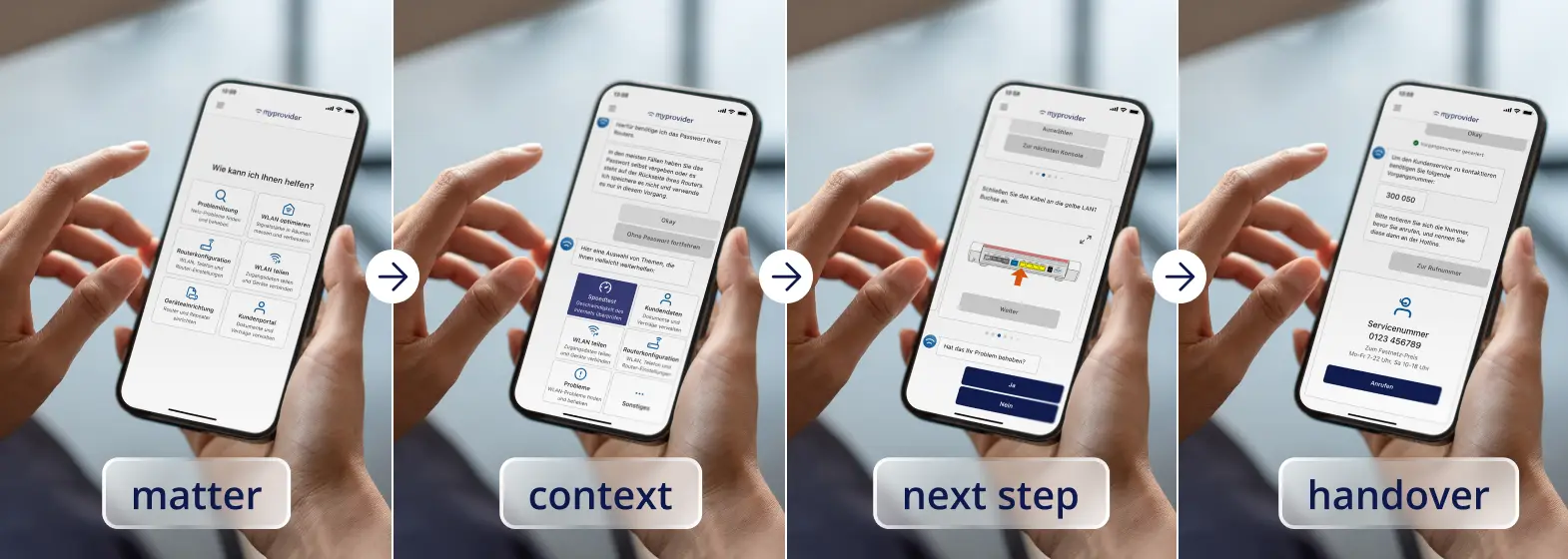
In technical customer service, a conversational experience connects customer input with technical information. A simplified process for an unstable internet connection might look like this:
- The customer selects the symptom "Connection drops out."
- The service checks the current connection and outage status.
- A follow-up question clarifies whether all devices are affected.
- Router and Wi-Fi connections are checked.
- The service suggests an appropriate action step.
- The customer confirms the result.
- If necessary, the process and all information gathered so far will be handed over to support.
The process combines dialogue, diagnosis, and action. Customers do not need to identify the technical cause themselves.
What defines a conversational experience?
An interaction meets the fundamental criteria of a conversational experience if the following questions can be answered with yes:
- Is the specific goal of the interaction clear?
- Does the process take existing information into account?
- Do follow-up questions serve a clear purpose?
- Does an answer or a test result change the subsequent course of action?
- Is a concrete next step offered?
- Does the process verify the outcome of an action?
- Is relevant information preserved during a handover?
- Can customers see how their request will be processed further?
If the connection between individual steps is missing, it is more of a collection of information or a series of disconnected service contacts.
Frequently asked questions about conversational experience
Is conversational experience the same as conversational AI?
Conversational AI refers to technologies for processing and generating natural language. Conversational experience describes the flow and quality of the resulting interaction. A conversational experience can also be implemented using rule-based systems.
Is every chatbot a conversational experience?
A chatbot initially provides a dialogue channel. For a conversational experience, the interaction must also take context into account, derive meaningful next steps, and maintain the history of the conversation.
Can an app offer a conversational experience?
Yes. An app can combine multiple-choice questions, measurements, status information, and instructions into a context-aware workflow. Free-text input is not required for this.
What information is part of the context?
Context can include the specific request, contract and device data, connection status, technical results, previous answers, and actions already taken. The selection depends on the purpose of the service process.
What happens during a handover to support?
The support agent receives the relevant information from the conversation history to continue the process. This includes the request, test results, steps taken, and the reason for the handover.
Conclusion
Conversational experience describes a guided service process in which context, next steps, and continuity are interconnected. The term encompasses the entire interaction – from capturing a request and performing checks to providing recommendations and potentially handing off to support. In technical customer service, this structure helps to narrow down complex issues step by step. To see how conversational experience impacts customer expectations, loyalty, and the design of customer service, read our blog post Conversational Experience: The New Standard in Customer Service.