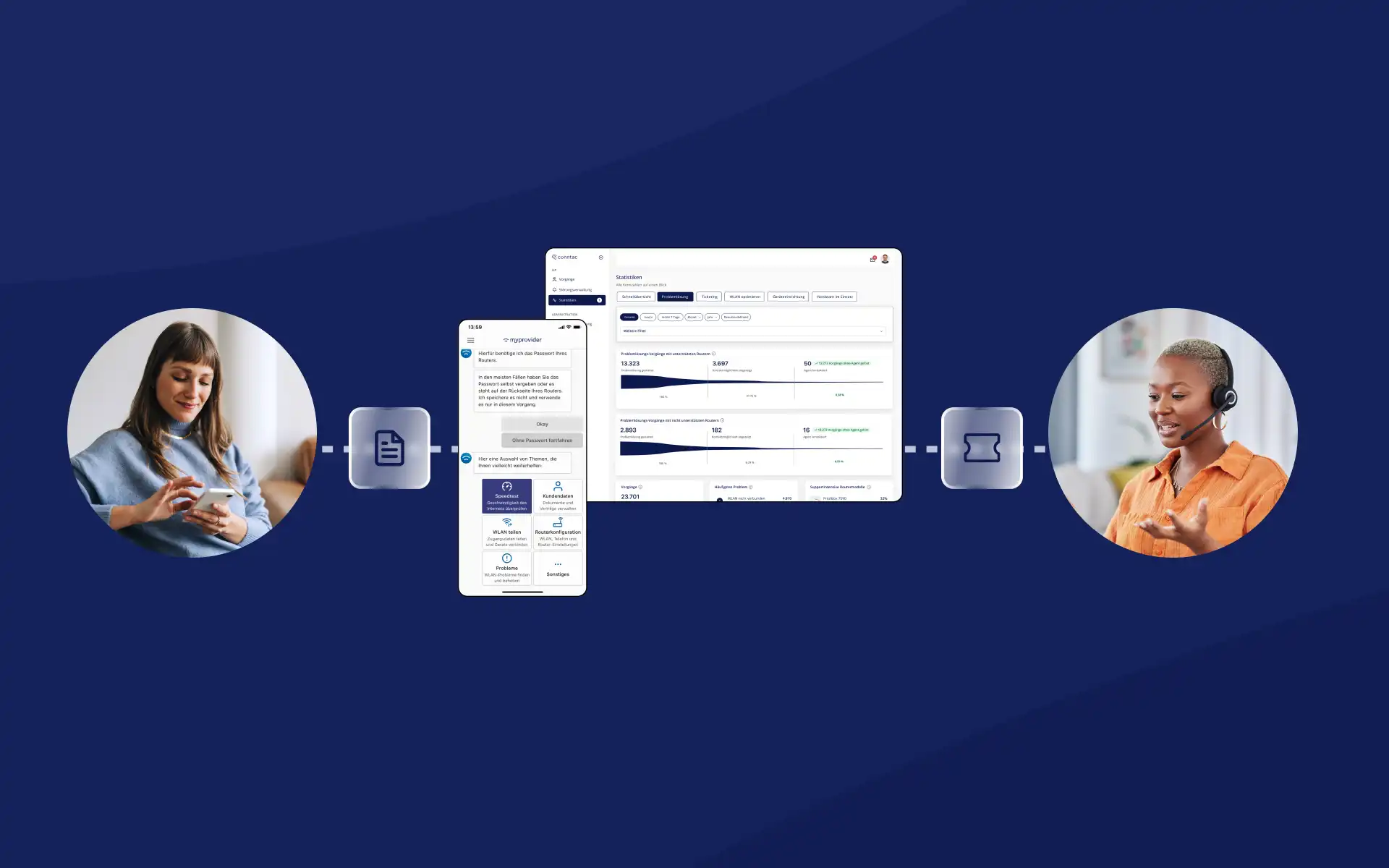
The cost of a self-service solution for internet service providers depends primarily on the scope of features, the existing technical infrastructure, the required integrations, and the number of customers to be supported. For budget planning, one-time project costs and ongoing operational costs must be considered separately. A flat-rate price without these key data points would therefore not be very meaningful.
For internet service providers, municipal utilities, and network operators in particular, the question of cost is closely linked to economic benefit: Which service processes can be digitized? How many support contacts can be avoided or better prepared? And what effort is required for implementation, operation, and further development?
At a glance
- The price of a self-service solution is determined by the scope of services, technical integration, and usage scenario
- One-time costs typically arise from conceptualization, setup, integrations, branding, and rollout
- Ongoing costs can include licensing, operation, support, maintenance, and booked extensions
- The number of customers is relevant, but it is not sufficient as a sole basis for calculation
- A reliable investment framework requires clearly defined service goals and technical specifications
Why the economic viability of self-service is gaining importance
Economic pressure in the telecommunications market is rising. According to the 27th Telecommunications Market Analysis by VATM and DIALOG CONSULT, 32 million households and small businesses are expected to have access to fiber optics by the end of 2026. The forecast predicts that 7.8 million connections will be actively used. This corresponds to a take-up rate of 24.4 percent.
PwC also describes the German fiber optic market in 2026 as a market under monetization pressure. For providers, it is becoming increasingly critical to convert built connections into active customer relationships more quickly and to manage growing service volumes economically.
In this context, self-service is an investment in the service structure. The relevant question is therefore: Is there a reasonable balance between implementation and operation costs and the expected benefits?
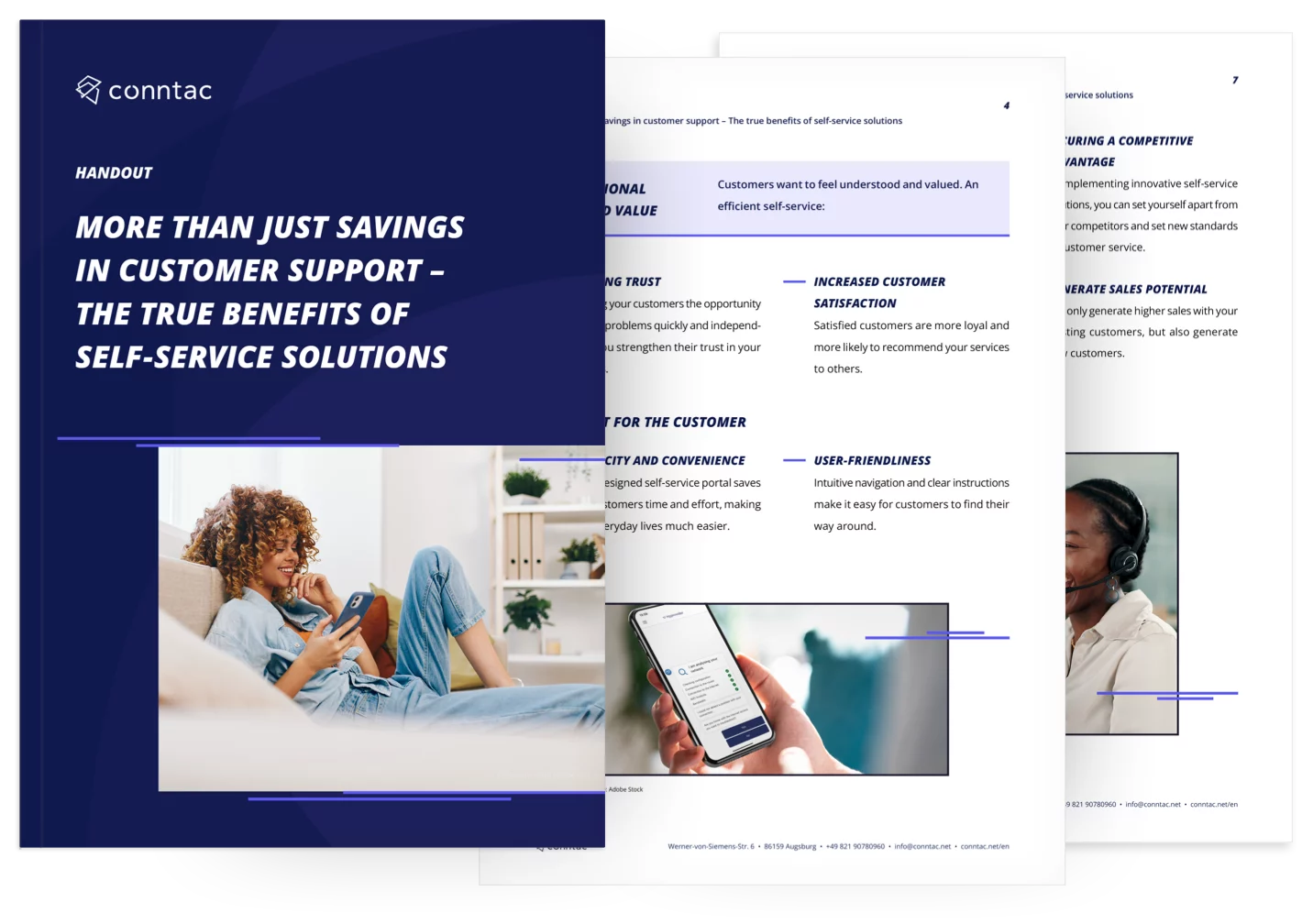
Read more: Calculating customer service costs: Why a support ticket costs more than just the talk time
What factors determine the cost of a self-service solution?
Six factors have a particularly strong influence on the investment required. These should be defined before comparing specific proposals.
Service processes and functional depth
The scope of supported requests is a key cost driver. A solution that merely provides information requires a different level of technical and editorial depth than a guided process that checks connections, isolates the causes of errors, recommends specific steps, and transfers structured data to support when necessary.
The following use cases are often relevant for internet service providers:
- Initial setup of connections and routers
- Diagnosis of internet and telephony issues
- Wi-Fi analysis and optimization
- Information on known outages
- Guided ticket creation and handover to support
- Clear explanations of technical terms
Prioritizing processes should be based on actual contact volume, processing effort, and the feasibility of resolving them via self-service.
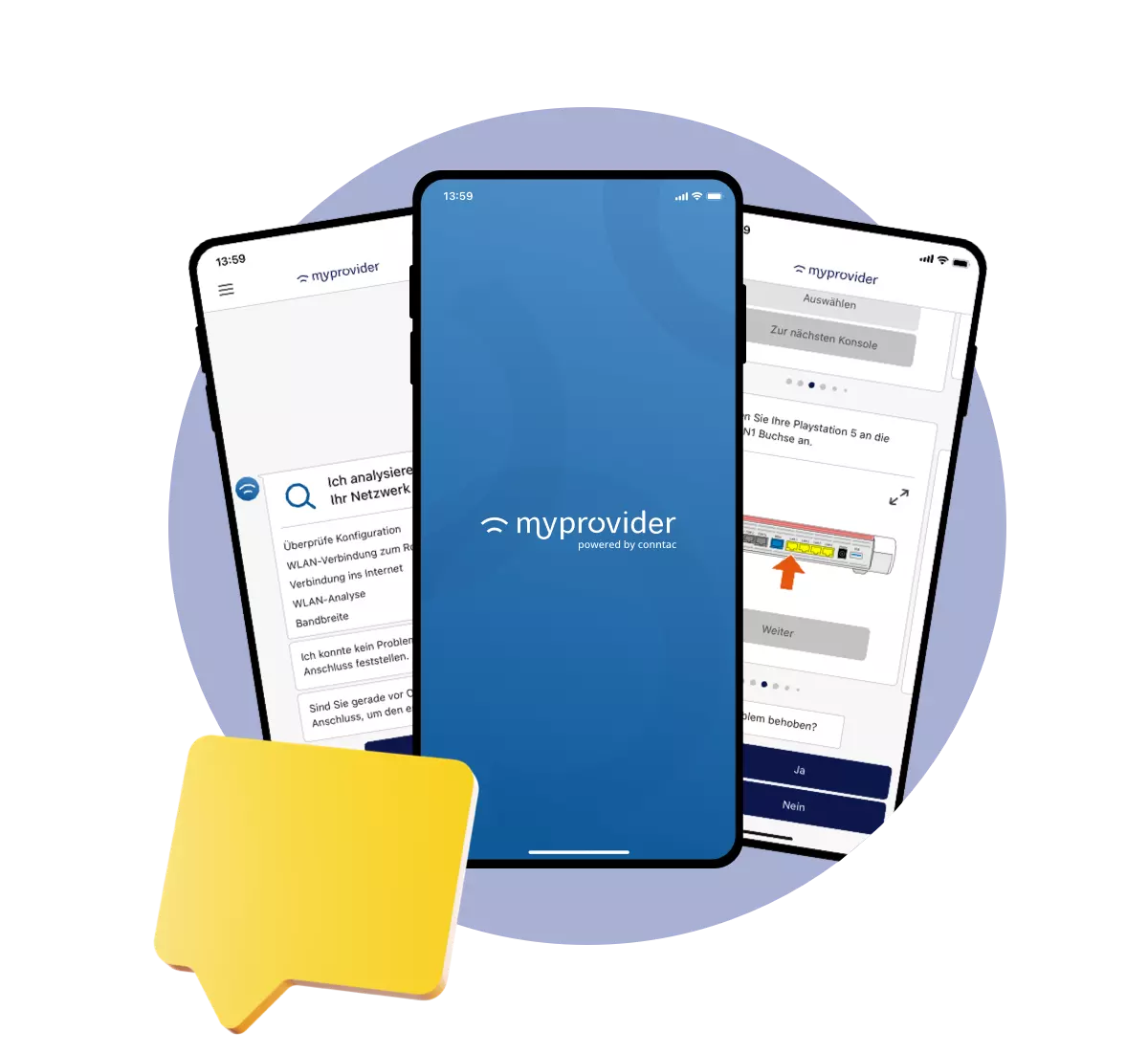
Read more: Which technical terms a self-service app should explain
Integrations and technical infrastructure
A self-service app delivers the greatest operational value when it can access relevant information and pass results into existing workflows. This may include interfaces to CRM, ticketing, customer portal, or network systems. The effort involved depends on whether suitable interfaces are already available, what data is being exchanged, and how permissions, data protection, and error handling are managed. Therefore, a price indication should consider integrations separately from the core functional scope.
Device and technology landscape
Internet service providers often support multiple router models, firmware versions, connection types, and plans. The more variants a solution needs to reliably detect and manage, the greater the configuration, content, and testing effort can become. The actual distribution within the customer base is the deciding factor. A clearly defined CPE portfolio is usually easier to map than a broad multi-vendor landscape with many edge cases.
Customer base and expected usage
Company size provides an initial indication of reach and usage. Two providers with 50,000 customers each may still require different investment frameworks. One provider might start with a clearly defined setup process, while another wants to connect multiple service workflows, different technologies, and existing systems. For a reliable assessment, customer numbers, expected usage, and functional scope should therefore be considered together.
Rollout
Branding, copy, legal requirements, role models, reporting requirements, and the planned rollout all influence the project scope. Training, internal approvals, testing, and the introduction to end customers also require time and dedicated responsibilities. A realistic cost comparison therefore considers the entire journey to productive use, rather than just the software license.
What one-time and recurring costs might arise?
For budget planning, providers should clearly separate cost types. The specific allocation depends on the respective contract and pricing model.
Additionally, it should be clarified which services are already included in the base scope and which must be commissioned separately. This allows for a comparison of offers without conflating one-time project services with recurring license costs.
Which pricing models are common for self-service software?
Self-service software can be offered under various models. Common approaches include fixed base fees, usage-based components, tiers based on customer numbers, and additional costs for modules, integrations, or custom services. Often, several of these elements are combined.
When evaluating an offer, the following questions are therefore more important than a single price figure:
- What services are included in the base package?
- What is the ongoing fee based on?
- What limits or tiered pricing apply?
- Which extensions are billed separately?
- What are the costs for additional customers, processes, or systems?
- What services are included for implementation, support, and further development?
A transparent proposal makes this logic easy to follow and shows how future changes will affect costs.
How can the right scope be determined?
A sensible project scope starts with service cases that have high volume, clear steps, and are technically straightforward to solve. Providers can evaluate their most frequent contact reasons based on four criteria:
- How often does the service case occur?
- How much processing time does it currently require?
- What percentage can be resolved without personal contact?
- What data and systems are needed for the solution?
This prioritization prevents a project from starting with too many edge cases. At the same time, it creates a foundation for the subsequent business case.
One possible starting point is, for example, router setup for the most important devices in the existing inventory. After implementation, further processes and device variants can be added. The prerequisite is an architecture that supports this expansion.
How do requirements turn into an investment framework?
For an initial price indication, a few structured details are often sufficient. The more precise they are, the better a realistic scope of the solution can be derived.
1. Describe the initial situation
This includes company size, number of customers, connection technologies, CPE portfolio, and existing service channels.
2. Define service goals
Should the solution reduce contact volume, simplify initial setup, pre-qualify support cases, or combine multiple objectives? Clear goals help with prioritization.
3. Select processes and functions
The next step is to determine which service cases will be supported and the required level of functionality.
4. Identify integrations and specific requirements
Relevant systems, interfaces, and branding or rollout requirements should be identified early on. Detailed questions can then be clarified during technical coordination.
5. Determine price indication
The initial assessment outlines the potential scope of the solution and the investment framework. A binding offer is only provided once functional and technical requirements have been sufficiently clarified.
How can the economic value be assessed?
Price alone says little about whether a self-service solution is worthwhile. For a business case, investment costs must be weighed against the expected benefits.
Relevant key performance indicators include:
- Number of service contacts per month
- Cost per support ticket
- Average handling time
- Percentage of recurring contact reasons
- Expected self-service usage
- Resolution rate without support contact
- Effort for remaining or pre-qualified cases
A reliable calculation should work with multiple scenarios. A conservative assumption shows whether the project can be profitable even under cautious conditions. Further scenarios illustrate the impact of higher usage or a better resolution rate.
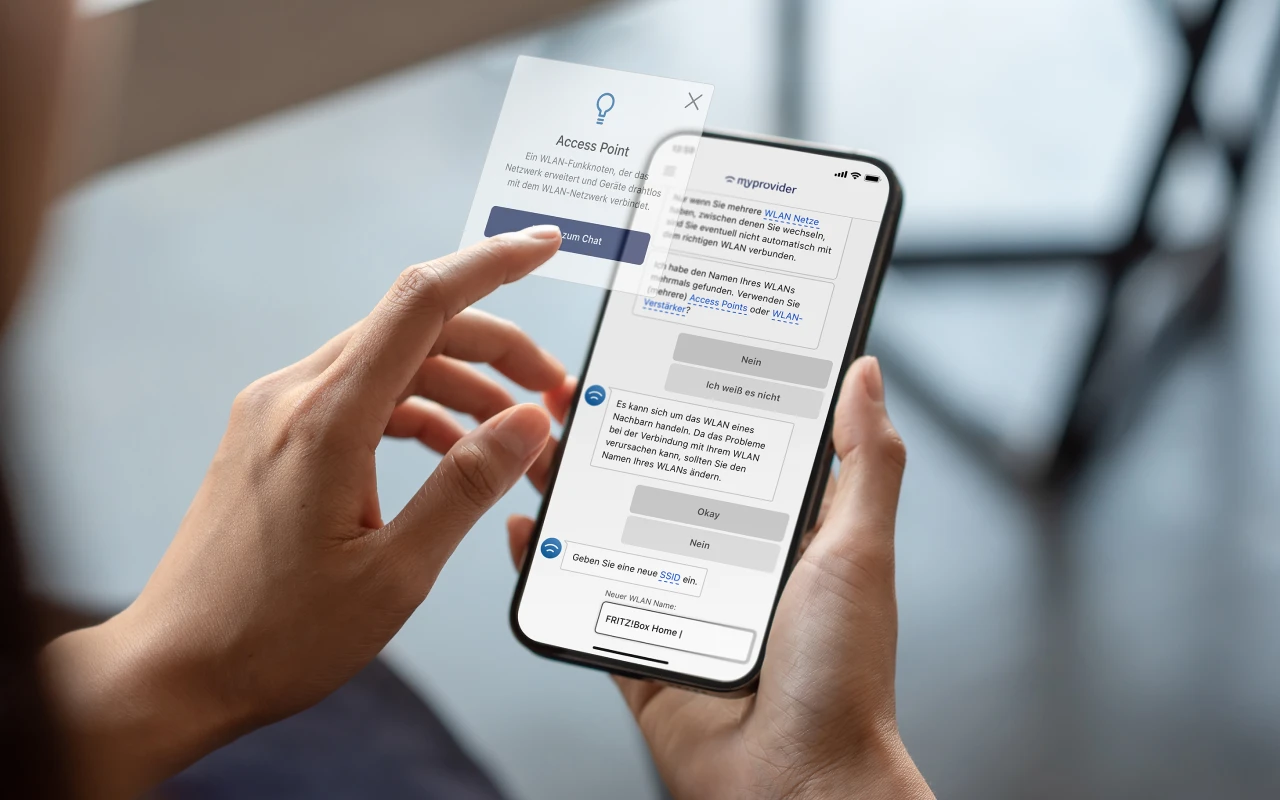
Read more: Customer Effort Score: Evaluating effort from the customer's perspective
Conclusion: Clarify the requirements first, then evaluate the price
The costs of a self-service solution can be meaningfully assessed once service goals, functional scope, technical baseline, and the planned rollout are established. A good price indication therefore shows more than just a number: it makes visible the underlying scope of the solution, which costs are one-time or recurring, and which points still need to be clarified before a final offer is made.
The MyProvider price indicator guides you through the most important key data regarding your company, service requirements, functions, and technical framework. Based on this, Conntac prepares an individual assessment of the potential configuration, relevant add-ons, and investment framework. The price indication is then presented personally and discussed together.
Which self-service solution is right for your company?
Provide some key details about your company and your requirements. Based on this, we will prepare an initial individual assessment regarding the potential scope of the solution, relevant add-ons, suitable configuration, and investment framework.
Request a price estimate
Sources
- VATM and DIALOG CONSULT: 27th Telecommunications Market Analysis Germany 2026, published on May 12, 2026, forecast values for the end of 2026
- PwC Germany: Fiber optics in Germany – A market under monetization pressure, 2026



.webp "Calculating customer service costs")
.webp "Less effort, more loyalty – Customer Effort Score (CES)")