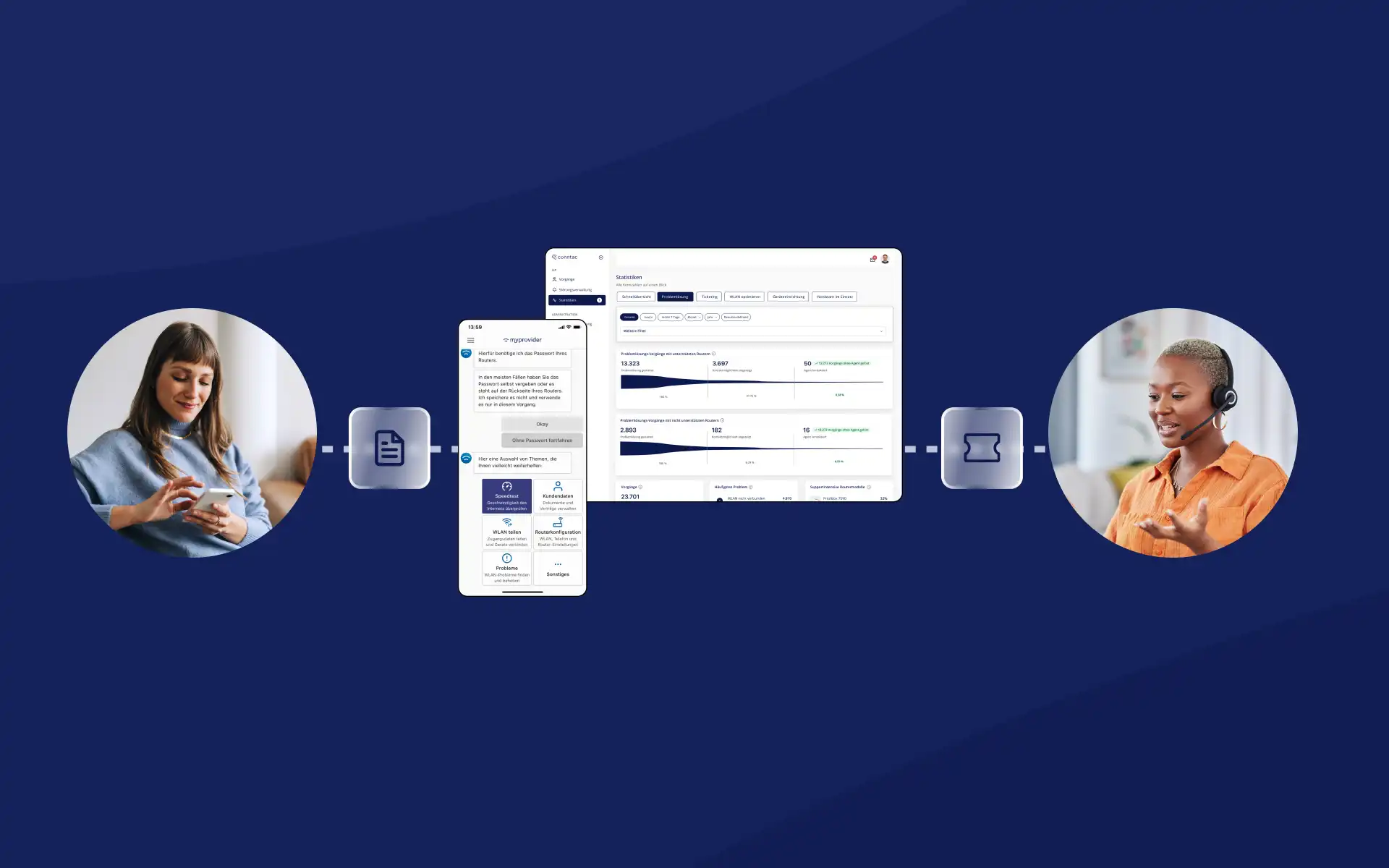
Internet usage is changing noticeably – particularly in markets with progressive fibre-optic expansion. A recent YouGov survey among 1,009 people in Switzerland (August 2025) clearly shows: Customers no longer rate their Internet connection solely on the basis of available bandwidth, but by reliability, safety and ease of use in everyday life.
For Internet providers, this sends a clear signal: Service and support processes are becoming a decisive factor for satisfaction and efficiency.
Fiber is becoming standard – migration as a service challenge
43% of respondents already use fiber optics, 26% cable, 12% DSL and 10% mobile access. It is remarkable that a large proportion of DSL households could switch to fiber optics today or in the foreseeable future.
For providers, this means two things:
- The growth potential is clearly FTTx.
- The migration must run as smoothly as possible to limit support costs and operational costs.
A central lever here is structured self-installation. Digital step-by-step instructions and guided processes start early and reduce queries even before the first contact with customer service.

Router reality: Provider devices dominate everyday life
78% of respondents use routers from their Internet provider – 45% buy them, 33% rent them. Own retail devices play a minor role at around 8%, partly due to a lack of legal regulations on free router selection in Switzerland.
The market shares of provider routers are as follows:
- Swisscom: 37%
- Sunrise: 26%
- Salt: 9%
For support, it is less important which router is actually used. Rather, the decisive factor is that the majority of customers rely on preconfigured provider devices – and that variations or expansions, for example through repeaters or additional devices, increasing complexity in the home network.
What customers really expect
From the interviewees' point of view, the following criteria in particular are decisive for choosing a router:
- Certainty
- Reliability
- Good WiFi coverage
- Speed
- A consistent price-performance ratio
88% rate these factors as important to very important.
WiFi coverage in your own home in particular is a common trigger for support contacts. In many cases, the cause is not the line itself, but in the home network – for example due to unfavorable placement, incorrect channels, sources of interference or mesh setups.
A structured self-service, which explains typical WLAN problems in an understandable way and provides users with targeted guidance, can intercept a large part of the contact volume here. Regardless of the manufacturer, there is a clear pattern: The more complex the household setup, the higher the likelihood of support requests. Combinations of modems, routers, repeaters and mesh components increase the need for explanation, particularly among non-technical user groups.
Trust as a strategic factor
The study reveals significant differences in trust in manufacturers:
- 51% distrust routers from China
- 56% manufacturers from Russia
- 41% brands from the USA
- Only 15% distrust European manufacturers
For Internet providers, however, the origin of individual devices is less decisive than the transparent communication during operation. Central questions from the customer's perspective are:
- How are devices secured?
- How do software updates work?
- How can problems be identified at an early stage?
A customer portal that bundles status information, tips and recommendations in an understandable way strengthens this trust in everyday life.

What this data means for ISPs
The Swiss data show a market that is technically mature and at the same time has high expectations for stability, transparency and support. For Internet providers, this allows clear fields of action to be derived.
Simplify migration – especially from DSL to fiber
Guided self-installation processes, visual steps and intelligent fault detection reduce installation costs and prevent unnecessary operations.
→ Easy to set up an Internet connection
Make WiFi optimization the standard
Subjective dissatisfaction often occurs in the home network. Self-service modules that explain WLAN channels, signal strength, positioning, or mesh setups in a comprehensible way provide noticeable improvements.
→ Optimize WiFi
Measure and classify Internet speed in an understandable way
An integrated speed test allows customers to comprehensibly measure the current Internet speed at any time. The results are contextualized – taking into account Contract speed, WLAN signal strength, distance to the router and synchronization rates – and supplemented with understandable explanations. In this way, performance deviations can be identified early on, correctly classified and, if necessary, converted directly into further problem solutions.
Communicate disruptions proactively and provide transparent support
In the event of internal or external disruptions, Internet providers inform their customers specifically and at an early stage. Affected users automatically receive information about the current fault, can subscribe to notifications and are informed about the successful resolution via push message. In this way, the status remains comprehensible at all times – without additional queries or hotline contact.
→ Report a fault and track the progress
Strengthen trust through transparent communication
Clear information on data protection, updates and security mechanisms is increasingly becoming a competitive advantage.
→ Customer portal for clear communication
Reduce support costs before they occur
Many issues can be resolved automatically, such as misplaced repeaters, bandwidth measurements, cabling errors, ONT status, router restarts, or PPPoE problems.
→ Troubleshooting the problem yourself
A clearly structured self-service path sustainably reduces resource expenditure and at the same time increases customer satisfaction.
Conclusion
The study makes it clear that customers do not expect a perfect network, but reliability, orientation and quick help in case of a problem. This is exactly where the central lever for Internet providers lies. Service processes that reduce complexity and enable self-help not only relieve support, but also measurably and sustainably increase satisfaction.


.webp "Rollout without IT effort")